Showing posts with label violin. Show all posts

Tuesday, May 13, 2014

Op.3 - Katrina Wreede, violist and composer

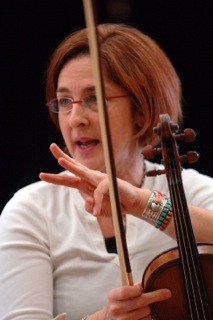
Katie Wreede, Viola
Violist and Composer / Founder, Composing Together


Besides creating the “Composing Together” and “My Goldfish Died-Blues for Strings” programs, Wreede is a founding faculty member of the John Adams Young Composer Program at the Crowden School, teaches Comprehensive Musicianship for the San Francisco Community Music Center, and is an accredited Teaching Artist for the Sacramento Metropolitan Arts Commission.  She began her work bringing youth to composition in 1998, when she became “Composer in the Schools” for the American Composers Forum-San Francisco Bay Area Chapter, later creating their handbook for professional composers learning to work with young people.  She has provided teacher training for American String Teachers Association, the Montana String Teachers Association, Bronxville Unified School District, San Francisco Unified School District, and Nevada County School District, and has taught for Oakland Youth Symphony, Young People’s Youth Symphony, Berkeley Youth Symphony, California Youth Symphony, and many schools around the country. Visit Katie online at katrinawreede.com

On April 9, 2014 I sat down to chat with Oakland-based violist and composer Katrina Wreede at my Quartet's office in San Francisco, following up an interrupted attempt at an interview several months earlier. Here's what happened...

---

Katie Wreede, we're back. We're going to pretend we didn't ever talk before.

Good, I had no idea what your project was for. I thought we were planning some new project (laughs)

Alright, so, basically, all I want to know is, how, going back – I don't wanna know all the cool stuff you're doing right now—I wanna know all the cool stuff you did back when you were a kid, that led you into music.

Oh!

What kind of activities were you involved in or interested in, what kind of stuff did you do—

Swim team!

Swim team?

I was—little girl ballet class, parks & rec...

Wait - remind me where you grew up.

Monrovia. And just in case anybody needs the information for, you know, identity theft—(laughs)

Oh, don't worry, it's all public record already.

It is. There's no privacy anywhere. I was playing a video game yesterday and it wanted some information, and I went to just get out of it, and it, like, auto-filled from something else without—yeah it's pretty creepy, scary...

So—my mom was an amateur clarinet player. Gramdpa played piano and zither. A Swiss guy who played zither.

He played at home?

No, it's just—he didn't play it that I remember hearing, but it was around. Mostly he was playing piano. And I remember going to his 90th birthday party and his playing Claire de Lune at the senior center.

My dad was a farm boy, got into science—but my mom felt really strongly about, you know, doin' that kind of stuff. And the parks & recreation had all these classes, so I did ballet class—I tried to do tumbling but was terrible. I never did a cartwheel. I liked it, but, you know... Karate... stuff—I did a parks & rec piano, group piano thing, where mostly we played Go Fish with the little cards with notes on 'em.

Flash cards!

Yeah, so, the whole notes on the staff – “I have a G! I have a G!” (laughs)

Was that your first musical experience?

Well my mom used to take me along to concerts sometimes. She played with the Pasadena City College Orchestra. I remember sleeping with the blanket in the front seats—

On the way, on the way back?

No, during the concerts.

Like at a drive-in

Yeah (laughs)

Sort of.

(laughs) Yeah. Music in the home, we had a recording of Peter and the Wolf—the Disney recording. And we had Firebird [Suite by Stravinsky], and we had lots and lots of Disney records, because my Grandpa had a Gulf gas station, and they were giving away Disney records—“fill up and you get a free record.”

So I listened to a lot of Disney music (laughs). And a lot of daytime cartoons. 'Cause I worked really hard not to have to go to class very much—I was... sick, a lot (laughs). So, lots of Bugs Bunny—I heard all the classical stuff on Bugs Bunny and Heckle & Jeckyl, all that stuff.

Looney Toons!

Yeah! And then I think around when I was about 7 or 8—Mrs. Scott. Piano lessons.

Mrs. Scott was probably—let's see, she was 110 when she died. She died when I was about 30. So, she was like, pushin' 90, and that was—that was a good first training thing. You know, she didn't hit me! (smiles) but she made me march around to the metronome a lot.

Sounds like you did a lot of different kinds of motion stuff as a kid. Ballet and Karate and tumbling..

Yeah! And Purple People Eater! A lot of dancing to Purple People Eater. (laughs) Slumber party stuff. So then you know, 4th grade: “What instrument are you gonna play” and they had the little aptitude test, and my mom saved the letter—the scholastic aptitude results—showing I had a perfect score on pitch recognition, something like that. So my mom hauls out her high school clarinet, says “You're going to play clarinet.”

So what's the farthest thing from (laughs) clarinet?—so, yeah, so... violin.

And I was a terrible violinist. I was really bad. I lasted about three weeks in the school program. The woman was such a witch, there was just no way I was going to spend time with her. So my mom hooked me up with Sue Rasmussen, and she was really sweet.

Tell me about Sue.

Local violin teacher—she was really sweet, and gentle, and let me get away with way too much, but it was nice.

Was it fun?

(tentatively) Yeah, I loved having lessons with her. I didn't practice enough. The thing that was really motivating was Saturday Conservatory, which was run by the guy I was studying with later—Mickey Fruchter—who I did private lessons with when I was kind of in that in-between—you know that time when you're deciding whether you're gonna go do other things, or maybe really commit to doing music?

Yeah, that's what we're getting to, isn't it?

Yeah, well he was that guy. The Saturday Conservatory was hundreds of kids and they took over Cal State LA every Saturday. We had group lessons, and we had chamber music, and that's the first time I played Eine Kleine [Nachtmusic]. And a full orchestra, I think they had, like, four full orchestras, and band... Huge, huge program.

I had lots of friends, and that's—you know, middle school, kind of, like fifth grade, sixth, seventh grade—when you're really starting to define yourself. And so I had this whole musical life, and—

Was it completely separate from your school life or did you have some friends from school who were also involved?

We had a couple friends that we carpooled with and the parents took turns, cause it was a schlep over there. But Mickey Fruchter was hilarious. He's the guy who taught me how to rub the bottom of the page to make it look like I'd been practicing (laughs). And he's the guy who said “Your parents paid for the whole bow” (laughs) You know, he was that kind of teacher. He made me laugh a lot. He drove a little dinky old Mini, it was very cool. He kept me entertained and intrigued at a time when I needed that.

This was still on violin?

This was still on violin, and when did I switch—no, I think I was playing viola by then. Let me think.... It's right around when I switched. Patty Greer moved to town—I was doing the middle school orchestra, which was really just five of us (laughs)—and she was just a whole lot better than I was. And I couldn't handle the competition. And nobody else was playing viola.

photo courtesy Katie Wreede
And at Saturday Conservatory all the viola players got all the attention. The violin players were like this sea of anonymous bodies, except for the first couple front ones. And the viola players were always the characters, you know. Yeah—Who would not wanna be the center of attention? In a good way. In a supportive, kind of, not-being-a-jerk kind of way.

So how did the switch happen?

David Stenski, who's a violinist in LA, was the teaching artist guy, the string guy for the school district. And he said “Well do you wanna play viola?” and he showed me the third position trick, and that was it—a couple hours and I was a viola player. There was no going back.

What was the main thing that drew you to the viola, other than 'no competition from other violinists?'

(laughs) Well, once you pick it up and you feel the vibrations, and you feel the C string and your whole lower half of your head (holds her jaw), just—your whole body responds to it. And then, violin, it just doesn't cut it, after you play the viola. (whispers secretively:) And you can play really loud. (laughs)

The school instrument I had, had no scroll. It was broken off and had this point (laughs), and boy I could make the C string go up like a major third, like vrrroooo! (laughs)

Did you start learning repertoire outside the orchestral and chamber music activities right away?

Well, we were playing pretty big string quartet stuff in middle school and high school, with David Stenski and Patty Greer. By then there were three of us. We were playing Mendelssohn Quartets, Beethoven... with David playing cello. (laughs)

OK, so that's Saturdays.

I was in Saint Gabriel Junior Symphony for a while, then I started playing with the American Youth Symphony, which is a paying gig. Not when you start, but there are union members, upper age limit's 30-ish, so everybody hung out till they got their professional symphony gig. That was with Mehli Mehta, Zubin's father. And he was Sir John Barbirolli's concertmaster. Big credentials.

So I got to play with Stern, Zuckerman, Barenboim, Lynn Harrell, a bunch of the MET singers. I don't think there's much of anybody I've accompanied in a professional orchestra that I didn't already play with in AYS.

I was one of the youngest people coming in, and I went all the way from last chair to principal.

How long did it take to... 'ladder up'?

(laughs) The whole time—I think the last two years I was in the front. You had to wait for the people in the front to leave. It was entirely up to him: everything was about Mehli, it was his puppy. My very first rehearsal—he used to scream and yell, and he'd sit on top of the piano, and he'd wave his arms around (demonstrates), and my very first rehearsal, some of the 2nd violins were having trouble getting set up in the back. There weren't enough chairs back there. And he picked up a chair, and he heaved it all the way to the back of the room! (laughs) Yeah. This is the guy who told me I sounded like a moose.

How nice!

Yeah—

I'm sure that was inspiring, motivating.

Well, yeah—any attention from him was good! “He knows who I am!” (pretends to swoon) When I was with Turtle Island and we played at Royce Hall at UCLA and I called him from backstage—this was like 10 years after I'd left, and I still had his phone number memorized, because he would always yell his phone number at every rehearsal: “If you're not coming you have to call me, 472-2226, you have to call me!” (laughs)—

So I called him! And you know, I hadn't talked to the guy in—there were a hundred people in that orchestra and it'd been going for years and years and years, and so many people had big important jobs that came out of that orchestra—and first thing he said, “I suppose you want me to come to the concert now! You didn't tell me in advance!” He knew exactly what I was doing. He knew I was there that night, he knew what everybody was up to.

What else were you up to as a kid?

Well, I was really fat. Not much exercise. Smog in LA was really bad. I had pretty bad asthma. The asthma-bronchitis thing was one of my tools for getting out of going to school! (laughs) but I did have really bad asthma, and it was before the inhalers.

What would you do?

Try to be as still as possible and sip cold water. And, you know, (gasps a couple of times to demonstrate)

So the swimming helped, so I took Red Cross swim classes and eventually took water safety instructor, my teacher for that was a guy named Greg Bland, who had won a couple medals at the Olympics. Who had us practice mouth to mouth on him. (laughs) Things were different! (laughs) And he really encouraged my parents to have me do swim team. At which point I dropped like 25 pounds. Instantly. Which reminds me I should go swimming. (laughs) I should try it again!

So I got heavy into swim team. It was like, Swim Team. And I was actually a 14 year old, Southern California backstroke gold medalist.

Cool! Did you look forward to the swimming as much as your playing?

I would go to school and do my homework at school, and my mom would pick me up for a lesson or rehearsal or whatever it was, and then swim team, and then I'd either eat in the car or maybe go home for a little bit, and then have a rehearsal in the evening, you know, that was my life. My poor mom.

Would she be there at rehearsals or would she drop you off and come back?

Usually they'd work it out so one parent would do one thing and another parent would do another thing. The minute I was 16, I was the carpool driver.

So AYS—and Wildwood Music Camp, which was a brief split from Isomata, which is now run by USC. There was a schism between the management and the faculty. The faculty moved to the next camp down the road, and they ran Wildwood Music Camp as a separate thing. When I was the right age to do those things I was at Wildwood, and then the faculty got back together with management and they all moved back up the street. Wildwood Music Camp was a big deal.

Did you travel much?

I did Congress of Strings – the Musicians Union's answer to when all of the string programs were getting dropped and the band programs were still active and the quality of players coming out of high schools was weighted towards the wind players. They were trying to build up string stuff. I spent a horrible summer in Cincinnati, being kind of treated nastily by Gunther Schuller. There were some other famous people I got to work with, none of whom I can think of right now! He made an impression, though.

At what point did you feel like there was “no turning back” heading into music?

15. When I started practicing seriously on my own without getting nagged by my mom. It was really hard!

Was it a big decision to change your focus that way, or did you just realize you were there?

It was the combination of a lot of my social identity and something that was really hard that I really had to work at, to be even OK at—versus a lot of the academic stuff I was doing, which was—cause I went to a really crappy school that just wasn't very interesting—it wasn't hard enough. There's a lot of reward with music.

And the swimming thing, I really liked, and I had some really good coaches and I had some friends doing that too—one of my teammates was on the Olympic team that she ended up not getting to swim cause it was the one we boycotted. Good swimmers, but the music thing, I dunno...

Was it more chamber music or orchestral playing that really grabbed you?

source: crowden.org
I did a lot of orchestra training cause that's what Mehli Mehta did, prepare people for professional orchestras. I thought I was going to be a symphony musician, and chamber music was what you did for fun on the side, for artistic satisfaction and all that.

I did symphony for a while. I was temporarily ranked third in San Jose Symphony, I was principal in Fremont Philharmonic, I was principal in Santa Cruz Symphony. Played a lot of opera, and I was first call for Oakland Symphony. Similar in L.A. before I moved here.

What brought you north?

It was because I was living with this tuba player. (smiles knowingly) And he was sleeping around. And he got the job in San Jose and he was commuting back and forth, and I found out—oh, So if I just move to San Jose, um, he'll behave himself! (laughs)

I was also having major disputes with Louis Kievman, who I was studying with. He was one of the original NBC guys, he sat right behind Primrose.

It was bad with Kievman, it was really bad. I revolted, and he didn't like it. He was one of those “You WILL take this job, you will NOT take that job. You can NOT take this class”—he was really controlling. And he played us against each other. He'd be like (leans in) “you know, I heard Carrie play that same etude last week and when there's an orchestra job only one person's gonna get that job.” And he used to hit and kick us and stuff.

I was with him in the late 70s, early 80s. '78 I started with him. He was an old guy already. He was at Julliard in the twenties, and his teacher was an old guy then, Sasha Jacobson. You know, I'm like, two generations from the mid-1800's of teaching style. That's pretty amazing.

It's an amazing perspective to have access to, but it's also so alien from where you are today.

Yes. Mehli Mehta performed for Saint Saens. (laughs) That's a long thread!

So I was in San Jose and I started doing wedding gigs. I finished my degree at San Jose State—I had been at Northridge, and basically there are two tracks at Northridge, which were: actually take the academic classes and get a degree, or hang out until you land your symphony job. I was in the “hang out until you get your symphony job” crowd. The average age in that department when I was there was probably like 28, just people getting their bachelors.

So when I moved up here I went to San Jose State, and I filled in some holes and got the degree.

What was the chamber music scene like at that time in the Bay Area?

Well, gig-wise, for starting-out groups—I just put posters up and there was plenty of work (laughs) And also a lot more playing house concerts, the kind of actual paying stuff for quality performances.

Did you have to make a lot of calls to get your name out, or you'd really just put posters out?

I put posters out, had a couple newspaper ads. For a long time my main income was one ad in the Chronicle. Cost me forty bucks a month, ran four days a week, and by the time people called me they were already sold and I'd just fill up my calendar.

How did Turtle Island happen? You were one of the early members.

(side-stepping…) You know, yesterday one of my students was talking about that video that's going around about the Strad viola for sale. “Oh, he's so wonderful!” So I hauled out Maurice Riley's history of the viola books to see if that viola was in the book, and Kievman and Virginia Majewsky, who I'd also studied with, they and their Gaspar da Salos (Sali?) were in there. And I'm looking through and I was able to show the book to my student and say “This was one of my bucket list things: I'm listed there in the second volume.” But it also has all this bio stuff that has nothing to do with anything I'm doing now, including Turtle Island. (long pause, then laughs) And teaching at Santa Clara University. (laughs)

OK—what was Santa Clara University like?

I haven't been there since they upgraded the department. There's always been a big vocal thing. Organ, keyboard. They have a beautiful facility for everyone now.

Katie Wreede with the Instep Quartet playing jazz
at Santa Clara University
When were you teaching there?

I don't even remember. When I was living in San Jose. Maybe when I was living in the mountains, in the shack.

Wait, when were you in Turtle Island?

'89-91. I was after Irene Sazer. There was a woman named Laurie Moore who was the first, but she's not on any of the CDs so people forget about her. There have been so many now.

OK, so I'm doing a lot of wedding gigs, and Opera and Symphony and shows. And getting really burnt out. Mark Summer was new to the area, and really needing work, 'cause he'd just come to be in Turtle Island but Turtle Island hadn't hit yet. So I was using him in wedding gigs and I was doing cheesy arrangements of, like, Babyface and 20's and 30's music, and I had no idea what I was doing. I was just trying to lift it off of piano parts. But really needing to branch out from playing Mozart Divertimenti. And we were doing the Tchaikovsky Serenade for Quartet, stuff that's fun but really not right for weddings.

I needed a violinist and Mark says “Oh, we just—Irene Sazer just moved to town from Baltimore and you guys would really hit it off.” The three of us started doing trio stuff, and the deal was, I was paying them more than I was getting, and booking everything, and they were supposedly teaching me how to play jazz. (laughs)

The Skyline Trio, which is still in existence and has had about 80 people in it—that was going to be the moneymaker and Turtle Island was going to be their artistic thing. (laughs).

So we were doing concerts as Skyline Trio, gigs and stuff, and then Turtle Island's cranking up, they got more and more serious bookings. So they were still kinda doin' the trio thing, and I was doing a lot more arranging and I was taking jazz lessons with David Balakrishnan, and I had cut all my other work except for one opera gig, cold turkey—just quit everything to learn jazz.

Was that hard to do?

No. No, 'cause I was really burnt out. The symphony thing got to me—the symphony thing was not American Youth Symphony. It wasn't hanging out with my friends and playing good music. It was not that.

Did you think about that a lot, what you had expected, or what you missed?

Yeah! But it wasn't that. (smiles) It didn't have the freedom, or the friendships.

Not as inspiring as it had been.

Yeah.

So I was friends with Mark, I was friends with Irene. So she quit TISQ – the split happened, and they asked me to fill in on one concert because, how many jazz viola players are there? Even though I wasn't quite the right player—I was doing really avant garde stuff, not swing and bluegrass, that kind of thing. But I knew their repertoire.

So I played with them for a little while, and then they asked me to be a regular member because they weren't used to a viola player. Irene is a really great violinist who doubles. They hadn't had the experience of somebody who was happy to fill out the middle and support all the sides, you know... The whole inner voice thing. They'd had four stars and nobody for the the guts part. I had that trick—it's the viola mindset.

I got to tour and do all the fancy stuff, and I learned some things, and I learned some things I don't like. Artistically, the bluegrass thing didn't sit well...

You wanted something more—

I wanted things that drew from my strengths too. The other guys didn't have any of those sounds in their heads.

Did you feel like you lost too much of yourself to their sound world?

They were expecting me to have been in a garage band in high school, and I never did that. And they'd say “Oh we're gonna do Crossroads by Cream”—“Who's that? Eric Clapton? Huh?.. (sheepishly) I've been listening to Shostakovich, Walton, Bartok... Miles! Oscar Peterson! Monk!—Bartok and Monk...but not the other.

Now, though, it's kind of what I do for wedding gigs! Rock and pop on viola (laughs)

And you're busy teaching now?

I'm not teaching that much… about 5 private students and a couple classes at SF Community Music Center. I've got the composing thing going, although I haven't really had time to write music that I want to write, for a while. I thought that that Prelude sextet [from ViolaMANIA 2.0] was quite nice.

It was!

It was not campy. I thought it was very respectful of the piece, and it didn't—I felt really successful about that one. 'Cause, you know, it could have been bad. It should already be in the AVS free downloads library, and I'm gonna put it on my new website as a free download.

Have you been into Viola Society stuff for a long time? Were you a viola fan from early on, or were you just a violist?

I went to the Viola Congress with Tom Tatton, with the Southern California Viola Society, when I was 17, 18, something like that.

What was that like?

That was—“Whoa! There's William Primrose!!” He did a master class right before our group performed, and some kid got up and played a movement of Bach, and he said “What are you doing with these fingerings???” and the kid said “These are your fingerings from your edition!” (laughs)—so that was permission to play Bach any way you want.

So I did that, and then 10 years later I was there as a presenter, presenting C String Blues: blues for mass violas. Not as good as My Goldfish Died Blues workshop, but basically the same concept.

Had you been doing that kind of thing previously, or was that a sort of experiment for you at the time?

That was probably my first time, because we were sort of doing that kind of thing with Turtle Island, but I was the only one with actual educational experience. This is why I'm enjoying hand-picking who I do Composing Together with, because there are still some people who think doing a school program is getting up in front of the kids and saying “Hey look at us, we're so wonderful”. You guys [the Cypress String Quartet] don't do that, you have the whole thing that integrates beforehand and everything. But not everybody has that attitude. The idea is, making a music program that gives people new skills and connects them on a human level. I like that.

Well, I think you are doing amazing work as an educator for all ages.

Composing Together! I'm going to try to get a grant from NASA. You guys should check this out—after my application's in [smiles]. I really want to do a big project that relates to STEM (science, technology, engineering, math). I hope a lot of the organizations that are applying to NASA don't have anything like music composition and they're looking for pre-formed kind of projects that they can just slip in [to the application]. And I really want to work with kids to write music to communicate with space aliens.

Katie Wreede with a group of Composing Together participants
source: arkenews.net
I'm doing a Fibonacci theme this year—Fibonacci: the numbers in music—so it's not that far afield. It's systems and sets of numbers, and finding patterns in sounds and lengths and pitches, and that's STEM all over the place! Finding patterns is finding patterns.

Good luck! When's the deadline?

The date just passed but it's a regular thing. So I just have to get it done for the next round.

Well, what are you busy with now?

Going forward? Performing, composing, and sharing that with other people, and just finding ways to make those all kind of work together. I'm developing an incarcerated youth program.

Yeah that's just what I was going to ask next, if you're working with prison youth!

I am working on that, inspired by California Arts Council—not funded by it.

So how does that work?

Stanislaus, Contra Costa, Fresno County, Sacramento County are all interested so far—so here's my scam for between now and November. I'm working with a therapist who works with troubled teens, and who's also done stuff at San Quentin. We're putting together the basic show.

source: katrinawreede.com
It's gonna be music, talking about how music is created and how communication happens in music- combined with exercises and using breathing to calm down, and communicating with “I” statements, and probably some other stuff involving improvisation and feelings.

I'm going to hire Jan, the therapist, to do a workshop with all of the Composing Together musicians and composers who will be involved in the prison thing, and have her coach us on how to talk, and what to expect. And then we'll have a fundraiser where we test out the show on non-incarcerated people with checkbooks. Hopefully people will actually show up!

I have contacts from people who manage these facilities—sounds like as many as 100 kids at a time. A hundred kids locked up! That's really, yeah... I wanna try it, and hopefully we'll be protected—emotionally—enough, by having Jan Sells there, she's gonna be the facilitator.

I'll be discussing the music part an she'll be doing the stand-up-in-front thing—she'll be the buffer. If we're 'fore-armed' enough I think it could be really cool work. 'Cause when you talk about, you know, under-served populations—I don't know if I told you, I called one place and she says “Oh we'd really love to have you but we have no money, not all the kids even have blankets.” Isn't that heavy? Getting locked up, for acting out, you know. You're like 14 years old and there's no blanket for you.

All these places—'cause all the money is going to these giant for-profit prisons, and everything is set up to funnel kids through school directly into jail, and then directly into prison. —But that doesn't mean that I want any of these kids knowing where I live...

Right – it's a terrible conflict of wanting to help but also needing to keep your distance.

Yeah, but they're people. And maybe a few of them... maybe...

It's a lot like any outreach – most of them will just go on with their lives after you've played for them, but every once in a while you'll really make an impact on one, or some—

Or even a little bit, even just a 60 minute respite. Just—a little moment of peace, or a little moment of organization in their lives. As long as I, and anybody I bring with me—as long as none of us are damaged... Isn't that valuable?

Wednesday, June 5, 2013

Op.1: Cookie Segelstein

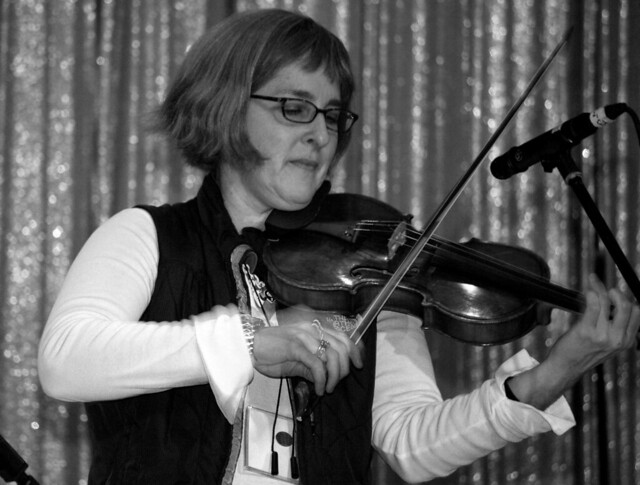
Cookie Segelstein, violin and viola, Veretski Pass / owner-operator, The Macmama
May 31, 2013

Cookie Segelstein, violin and viola, received her Masters degree in Viola from The Yale School of Music in 1984. [READ COOKIE'S COMPLETE PROFESSIONAL BIOGRAPHY HERE] She is principal violist in Orchestra New England and assistant principal in The New Haven Symphony Orchestra. She is the founder and director of Veretski Pass. Cookie has presented lecture demonstrations and workshops on klezmer fiddling all over the world. She was on the music faculty at Southern Connecticut State University and has been on staff at Centrum's Festival of American Fiddle Tunes in Port Townsend, Wash. She was featured on the ABC documentary, “A Sacred Noise”, heard on HBO’s“Sex and the City”, appears in the Miramax film, “Everybody’s Fine” starring Robert De Niro, and heard on several recordings including three Veretski Pass recordings. She is also the publisher of "The Music of..." series of klezmer transcriptions. Active as a Holocaust educator and curriculum advisor, she has been a frequent lecturer at the Women’s Correctional Facility in Niantic, CT. Cookie is also an Apple Certified Support Professional, and owns and operates The Macmama. Cookie lives in Berkeley, California. 

I spoke with her by phone in May 2013. This is her story:

I was born in Kansas City, Missouri. I lived there till I was 24, because I got my undergraduate degree at University of Missouri at Kansas City. I went to Yale in 1982, and then I lived in Connecticut until 2010. So I lived in Connecticut, what’s that math, 28 years, something like that?

My parents are both Holocaust survivors, and their English was very - it was not used at home when I was little, until whatever became the Jewish Federation, or whatever it was called, sent English teachers to all the survivors. I remember this woman coming to the house and scolding us for not speaking English. I was about 4, I remember her saying [pretends to shout] “Only English in this house!”

We were always around survivors’ kids, so we spoke Yiddish, or in my case Hungarian. And then as we started to enter the American world, we started to speak English, and then we became translators for our parents...

Basically that’s also how I got into music: my father handed me a violin and said “Ok, you’re going to play now. Here. You’re gonna play this” and then he would sing me songs, or tunes, and I’d play them, people would cry, and I would go, “Well this really sucks! I hate this, it’s no fun for anyone! I hate this!” It was evocative of pain...

So I was really forced into music, I didn’t want to do it. And then my violin teacher was another survivor’s kid, who was, you know - I don’t know if you can print this, but - batshit crazy, and scary! And I was like, “Wow, this whole music thing is for, you know, bad dream people.”

I was going to be a veterinarian. I was crazy about animals - I still am. If it was up to me I would be that cat lady, I just wouldn’t weigh 5000 pounds. First I wanted to be a cowgirl, and then when I realized that that was a TV job and not real... Probably at the age of about 8 or 9 - I actually remember getting my first cat for my 8th birthday, I was crazy about that cat. And then going to the veterinarian - and going “Hmm (lightbulb!) maybe this would be a good job.”  

So I was really going to do something with animals. Even into high school -- until I took chemistry in 10th grade, and I went “Ohhhh... yeah I can’t quite do this, this is really hard.” I just couldn’t handle chemistry or math.

So I was playing violin (I started when I was 5) and then in school I joined the little school orchestra in 4th grade. I was also taking classical music lessons at home. I was playing Jewish music at home, and then in my lessons I was playing Onward Christian Soldiers, Bach Minuet and all this stuff. I had a series of violin teachers. Some very nice, some really scary.

And I never considered it as a living, it was just something - I started to enjoy it a little bit in Junior High School, because there was a community of kids in the orchestra that was kind of fun.

In high school we had a really good orchestra conductor who was very, he was kind of the one people went to… He was very cool, a place to - he was a refuge in tough high school years. He said we were gonna have a clinic with the Kansas City Symphony. He needed viola players for the orchestra - I was in 10th grade - and my sister was in the orchestra and she said she would switch to viola because they needed more. And I wasn’t gonna do it, but then she said she wouldn’t do it anymore, she was going to drop out of orchestra, “But would you do it?”

So I said “I don’t want to do it, I don’t want to switch to viola.”
And she just said “Oh I’ll give you Five dollars” [laughs]

So she gave me five dollars, and I said to Mr. Alter, the teacher, “I guess I’ll switch to viola and see what it’s all about,” and I did. And then - I basically played by ear anyway, but - I couldn’t read the viola music and wanted to quit. He said just wait till after the clinic with the symphony, because I was already the strongest player… which wasn’t saying that much.

So the symphony came and they did their clinic, and the viola players were so nice, and they weren’t insane, and they - I remember one guy had a viola that had, like, a lion’s head on the scroll, and of course being the Jewish woman and attracted to bling, I went “OH, cool!” and you know, when he let me play it and it was so - the tone was so much better than what I was led to think...

I started to take lessons from Hugh Brown, who was teaching at the conservatory there, and I started to actually practice. And then the next year I took my bat mitzvah money, which was about $1200, and bought a little Italian viola - or a pretend Italian viola, I don’t remember. My dad helped me with that, and I started to be serious.

My father was a very difficult person, but  I was kind of his favorite, and I said “Well, I think I‘m going into music.”
And he said “You don’t really have the discipline for that,” and I got really upset.
And then when I calmed down and he realized how much he had upset me, he said “Ok, I’ll do whatever you need, I’ll get you whatever you need, I’ll support you in that.”

So I started towards the end of my Junior year kind of realizing that I was going into music. And I didn’t think of applying to other colleges [besides UMKC]. I just, for some reason, because I had to do all that - my parents couldn’t fill out any applications - I was just like, “Well, I’ll just go to UMKC, and study with Hugh Brown,” because I’d already been studying with him. I did that as an undergraduate, and then became, you know, bored. And he was very easy [on me as a teacher].

I was also very involved, by the way, in teaching horseback riding. [laughs] I was the head wrangler at the Jewish Camp, Barney Goodman, which I had been since I was 14.  Plus, I bought a horse when I was, let me think, 16. So I was really into horses.

As a matter of fact my mother went away to Cleveland to visit a friend and while she was gone, I bought that horse. [laughs]

One of the other refugees, he didn’t have any kids and he kinda was our Secret Santa all the time - you know, that’s a funny thing to say as a Jew, but - he kind of like, if there were things our parents wouldn’t help us with, he would say (whispering) “All right, be quiet, here, here’s fifty dollars”. He knew I wanted to get a horse, and he made this deal with me that I would take his mother shopping every Saturday morning. I think she was ethnic Hungarian but had been living in Yugoslavia. I used to pick her up in the morning at about 8:30, take her to the grocery store, waddle through the grocery store with her for about an hour and a half, and then take her home, unpack her groceries... That’s what I did for her, and he then helped me pay for my horse - the winter months for my horse, and he gave me gifts, money for my car, you know... He kind of subsidized my horse thing.

So my mom came home [from Cleveland] and I said “I bought a horse,”
And she said “What do you mean you bought a horse?”
I said “Yeah, I just bought a horse.”
She looked at my father and she said “You let her buy a horse?!”
And he said “Whaddaya mean, ‘LET?’ I can’t -- LET?? She’s a grown woman!”
Of course, I was 16.

So I had this horse and I was supporting it, and then, I mean, I paid for all my own education. My first year of school was $900. I was working, I had a job at Baskin Robbins, and I was house-sitting. I was bringing in money here and there. And then when I went to college I sold the horse to buy a bow for my viola.

It was terribly hard to do, it was really hard. I was teaching horseback riding at this camp but I had my own horse, and this stable charged $25 a month for the summer and $50 in the winter. I bought her barely - they call it greenbroke - she was barely trained. She was 2 years old, a quarter-Arab mare, and I trained her and I was crazy about that horse. I was out there every day.

And then when I needed a viola bow, you know, at that time it was like $350 or something like that and I couldn’t afford it, and there was no way I could go to my parents for it, they didn’t have the money. So I sold her. But she - Arabians tend to be one-man horses.

I sold her to this man, and they called me about two weeks, three weeks later, and said “You’ve gotta come and get your horse because she broke his leg. We think she’s gone crazy...” Because the guy that bought her - see, I never rode her with a saddle. I had a little bareback pad. He put this big saddle on her and she hated it. So he would get on her and she would sit down, with her back leg, and she would sit down and try to roll over to get him off her. So she rolled on his leg.

And so, I went out there, and I whistled and she came, and I rode her all day and I said “I’m gonna buy her back, I can’t stand this.” But my mother had called them and said “Under no circumstances can she buy that horse back!” So I got really upset. That was a very tough decision, and I’m still not sure it was the right decision! [laughs] But that was really hard for me and really painful, and I really missed -- anyway, he said “I’ll keep her, I’ll keep the horse.”

Working in that summer camp, we had to buy and sell horses. Going into the outskirts of Kansas City as a girl, with a black caretaker for the camp, to an auction to buy horses - he would say “You’d better drive, Cookie, ‘cause we’re going into Raytown (Missouri) and I’m gonna get pulled over if I’m driving with a white lady.” So I would drive, but the fact that we were sitting in an auction and I was a woman without a man, you know, bidding on these horses... I had people tell me “This is dangerous, don’t accept a drink from anybody, they’ll spike your drink, they don’t like to see a girl with this much... power...” I mean, I was in my early 20s, I had an expense account of $125, how much trouble could I get into? So I started thinking, you know, this horse business will be frustrating, I don’t think I want to do it.

Raphael Hillyer was coming to do a master class at Lawrence, Kansas University, so my teacher said “You should go and play for him. You’re pretty much, you know, the big fish in a little pond here, you should go play for him.”

I had dropped out of college for half a semester - I had a boyfriend and we were going to go pick fruit on the western slopes of Colorado and live like hippies and take hallucinogenic drugs. But that was just a little way to make my parents insane a little bit. I didn’t actually go, but I did drop out. I kept my private lessons and orchestra but dropped out of class-work for one semester.

So I went to this master class and he beat the shit out of me, and… I decided I should go study with him. He was at Yale, so then I realized I actually should go somewhere else [away from home] to go to graduate school.

I applied to a few places. I applied to Indiana to study with Abe Skernick, and I applied to Cleveland to study with Robert Vernon, and then Yale for Hillyer. And I got into everything but Yale gave me the most money, and Robert Vernon said “You can come here but you have to get a new viola,”

And I remember saying to him, “Well, how the hell do I do that?”
He goes “You’re cute, just get a sponsor!” like it was so easy.
I thought he was a total asshole and I went “I’m not going to study with this guy...”

Anyway, I ended up going to Yale, and Hillyer kicked my ass into gear. I really started practicing in graduate school. And by the way, I had - once I switched over, when I got older, I had stopped playing Jewish Music. When I thought about playing music from my family what ran through my mind was “I hate this, I hate it, hate it, hate it.” And I only came back to that when I had children.

It’s interesting. I always was interested in, like international folk dance stuff, so even when I was in undergraduate college, I played in a small group for international folk dancers, and we did, you know, Balkan, some Hungarian, all these different things. I was always attracted to that. We played for dancers, we played for parties and stuff like that, but I didn’t want to come back to the Jewish stuff. Occasionally there’d be - what was it like, they didn’t call it a Klezmer tune, they would have called it Israeli, it was just part of the pile of music.

The Klezmer revival started happening in the early 80s. I was just starting Yale and I wasn’t really interested, it just went by me. I didn’t even think of it as something I would be interested in, and at home we never called it Klezmer music. “Klezmer” at home meant the musician. So I didn’t hear Klezmer, I heard Yiddish music, or Jewish music, or music from home, things like that. Then when I had kids I thought “Shit, they’re gonna have to find out about my parents. They’re gonna ask questions. I’m gonna have to tell ‘em all of this stuff, I have to present them with their - ‘What did grampa do when he was 21?’ ‘Well,’ [laughs] ‘he was escaping from labor camp!’” [laughs]

I knew I had to present that to them, so I was trying to find a way, that there was something good also in their history. And I just started to get more attracted to it. The Klezmer revival - Emily was born in ‘88 - it was really kind of getting some people interested, gaining some steam, and then I decided to join the synagogue because I wanted my kids to go to Hebrew school, and just because we were in such a Methodist area I wanted them to have somebody who was similar to them.

Somebody at the synagogue said “We’re trying to start a Klezmer band” and I was bartering with them about the membership. Because my husband at the time was Ukranian and not Jewish, and not  too interested in, you know, paying any kind of membership anywhere, I said “I could kind of lead that, I could help with that as part of my - in exchange for my membership.” So I started that!

They said “We want you to go to Klezkamp in the Catskills,” and I said “Oh-Kaaay” and, well, I went there, and I loved it -- and realized that all of this music I’d been growing up with was now very popular with this certain group of people.

I remember I came home to visit my folks, I brought a tune home and said “Dad, listen to this, this is something you taught me but I learned it the right way.” [laughs]

I played him for it and he goes “Oh my God, what’s all this noise??” Cause you know there were all these ornaments and trills and slides and all this shit.
He goes “I can’t even hear the melody - What is this, Greek?” he couldn’t recognize it.
So I go “What-- what I’d been playing at home was what this revival was all about?”

Anyway, so that’s when I kind of started, you know - I actually started interviewing my father, as an informant for the music, and really got a lot of  information from the street, as it were- you know, I kind of put things together. I was interested in it now, and realized that the place he was from had the kind of music that I liked the best.

I became pretty busy in the New York Jewish club date scene, because I could read and I could play by ear, and I could stroll, and I knew all the tunes... You know, and I took showers. I wasn’t like a typical folk musician: I had a tuxedo, I dressed up, I showed up on time, and I... didn’t curse and spit. I shaved my legs, I colored my hair. You know what I mean, I looked normal.

So I was busy during the economic… happy time. In the mid-90s I had three to four a weekend. It was crazy busy. There was a woman in the New Haven Symphony who was also getting interested in this music, and she was the principal flute player. She became a pretty busy contractor for weddings - you know, people were starting to do this kind of live music at their events. They really wanted a Klezmer band. So I would have two on Saturday, one on Sunday, maybe one on Friday night even though the religious people wouldn’t do it on Friday night. There were times I would leave the house Friday at 3 o’clock, come home at midnight, leave Saturday at 7 in the morning, and get home at 1 in the morning only to leave again Sunday morning...

I was making about $1500 a weekend! And this was in the mid-90’s. It was because of the skills of being classically trained but also having the background in, you know, being able to plug into a sound system and play any of the Hassidic  music, all of the dance tunes, and then be able to play Pachelbel Canon for the cocktail hour, and then jump into My Yiddishe Mama  and then the crazy hora set, when they throw the kid, or bride and groom up on a chair. The only thing I didn’t do and still don’t do is Jazz. You know, “me no rock!” [laughs]

It’s interesting because if you gave me a Klezmer tune I’d be varying it right away, but it’s more like Baroque music - you take a melody and you kind of fill in spaces and you change cadences, and it’s not like Jazz where you do a solo over harmonic changes. It’s the opposite: you do the melody and the harmonic changes have to follow the melody. It’s a melodically driven music.

The harmony is secondary, almost like rhythm. If there’s no harmony and the people are just playing open fifths, that’s fine. It’s really about the melody and then the melody is there, usually to serve the dance rhythm. Like Jazz, there are some rhythmic treatments of pushing ahead or pulling back and, you know, kind of making the rhythms a little bit crooked, but I mean, I can do a solo on any of the Yiddish Theater tunes but it’s very tame... My husband is a real jazz head, a real jazz player, and he’s trying to explain it to me and I think... I think I’m just resistant to it. [laughs]

In ‘92, ’93 - pretty much from my early 30s, which is when I started - well, I had my first kid at 30, my second at 33, and I stopped teaching then. I decided I wanted to be home to raise them, and I was only doing playing gigs.

When I got out of college, out of graduate school, I auditioned for the New Haven Symphony, and I got in, and then I was in Orchestra New England, which was a chamber orchestra. Eventually, when positions opened up, I became - I think when my son was like, God, a couple months old - the assistant principal position opened up for New Haven Symphony. I practiced, I auditioned, I got the job. And then I also got the job to be principal of the chamber orchestra, so I was at that since ‘92...  I was doing all the core work for both of those orchestras, plus the club date stuff, plus the casinos opened up, so I had strolling violin gigs. I was really busy playing.

The Symphony got a grant to bring music to the inner city, and the conductor Murray Sidlin said “You know, I think you’d be good to do this,” so I went into three schools in the inner city in the afternoons, and I brought in a music program. But when I had my kids I kind of stopped teaching, I wanted to be home with them, and I was pretty busy working. So I was home during the day and out at night. Which was pretty horrible for my marriage, among other things. So that was probably from the age of 30, kind of, on, when I was busy, really busy.

And then the economy started to tank. There were dips, a crash sometime in ‘87, when I was pregnant, I was just about to be married and pregnant, and the economy took a downturn then. Some of the playing work dipped down, and then started coming back by the early 90s, and that’s when I was super, super busy.

Well, our trio had an agent, MCM out of New York, and they were getting us work and between the Symphony and the chamber orchestra and the strolling gigs and the work from our agent, I was doing pretty well.

Then the Madoff scandal happened, and a lot of the Jewish organizations that were, you know, pooling together to bring us in for residencies all over, even Indiana University, Ohio State, all these colleges... A lot of the Hillel organizations that were usually the bulk of our fee, ‘cause they usually would pool together the anthropology department, the history department, and the Hillel was usually one of the bigger donors, as were some of the local synagogues.

When we came to do residencies we would usually be there for 3 or 4 days, and we would teach, we would do workshops, and then at our concert we would have a spot for the students. This guy, this agent got us maybe between 5 and 8 of those a year. And you know, by the time we came home it was enough, padded with everything else I was doing, to make a - you know, I was not rich by any means, as you can imagine, but it was enough.

But then, when this happened, because a lot of the donors even for the New Haven Symphony and Orchestra New England came out of Fairfield County - well, Fairfield County in Connecticut got killed by Madoff. The city actually lost its pensions fund. So a lot of the donors, of any of the work I was doing, you know, withdrew their money from the endowments of any groups I was in. So the Symphony's services were cut almost in half, the Orchestra New England that I’d, you know, been principal of for almost 30 years, almost went into bankruptcy, and all of a sudden this huge chunk of income got kind of dropped out.

I wasn't teaching - I had stopped teaching because, you know, I didn't have to [laughs], to be frank... And in the end, my daughter, starting to enter college, luckily she was going to the RI School of Design, got a full scholarships, so I was ok - you know, my ex-husband and I were gonna have to pay maybe, with her living expenses, about 12,000 a year which was much better than we thought. Actually he was great about it - he had put money away when they were kids, so that was covered.

But when all of this happened, within about 6 months I noticed we were losing work: my agent would call and say “You know, these three residencies just dropped out” and then one of our European tours, which was going to be pretty much a half of my yearly income - our anchor gig there got canceled. So we had to cancel out on all these tiny, three- or four-hundred euro-a-piece gigs, and I was sitting there going “Oh My God,” and our son is growing... I was really panicking and I knew I could go back to teaching, but -- I enjoy teaching a day or two a week, I don't enjoy teaching 5 or 6 days a week.

So I was helping a friend set up a wireless network, and I was telling her, “I don't know what the hell I'm gonna do. My child support's gonna stop soon.” My ex-husband and I still, and did, have a very good relationship - I did not try to ream him during the divorce, and nobody pulled any funny business... Our settlement was just what everybody needed, and not enough to make him, you know, have to live out of his car. So I just was freaking out: To build up a teaching studio is gonna take me a year or two, and meanwhile my son who is starting to grow three inches a year and, you know, I'm telling him “Get away from the refrigerator, I can no longer feed you!" [laughs]

My friend said “Why don't you do this?”
And I said “Do what?" I didn't know what she was talking about.
And she said "This - you're not a 22 year old anti social geek - you're talking to me in a way I can understand, you're not giving me too much information but you're giving me enough that I feel like I can trust you...”

I had never even thought about computers [as a career], it was just not interesting to me. You know, when I was in 7th grade I remember we had computer class and the computer was in this room, it was the whole room. And you put in these little punch cards and it, you know, it added 6 plus 6, so who cares, you know - that didn’t interest me.

So I started thinking about it, and you know, I have a Masters in Music - I have no mathematics. I have no IT training. But I've always loved gadgets. Everybody always called me “Gidget Gadget,” 'cause if it was silver with lights I had it, and if there was a well written manual, it was like a religious experience for me: I was like, 'Wow, that was written well!'

[A little later] I was at Klez Camp, where we go - where the Jews go between Christmas and New Year’s. It's in the Catskills, it's been there since right when the revival started, I think it's in its 26th year. I've been teaching there for almost 20 years. So I was there, and one of the guys that is kind of one of the musicians but he also - he runs the office, he's also a Mac geek and he's written some books on Filemaker Pro, and I was talking to him about it, and he goes “Well why don't you just take the training, just get certified! And then put your shingle out, and most of the time you're gonna be connecting printers and, you know...”

I started to look into it - I looked up “How do you get certified by Apple?” I found that you just have to take a test, and they offer classes. And I was gonna take a class but the classes were 3 days, and $1500. First of all, I did not have $1500 to spend on a class, and at that time, I was in my late 40s - I don't learn in 3 days, it takes me longer.

So I decided I would buy the materials: the textbook, the certification for the operating system. I studied that, and I also bought the study materials to repair hardware, and soon realized I didn't like that - that's not fun for me, to repair hardware. I can change out a hard drive and memory, and change out almost anything in there, but when you start talking about soldering, I lose interest, I'm not interested in that.

So I decided I was just going to get certified in what's called ACSP - Apple Certified Support Professional - meaning, the only hardware I'm certified to do is to change memory. But I can, you know, wipe your system, I can do anything that has to do with the operating system and software and it'd be certified and I don't void your warranty. So I bought these books, and I bought a spiral notebook and a bunch of pens, and I friggin' studied for 6 weeks, about 4 hours a day.

I'd get up in the morning, I'd go play tennis, or ride my bike, or you know, prepare my kids' dinner, and I would sit down with my coffee or whatever from about 9-11, take little break and then study another 2 hours or so. And I basically wrote out the book - I took notes on the book... I filled up two spiral notebooks. And then I went back, took notes on the summaries. It was really like an intensive course I gave myself for 6 weeks, and my whole family was crackin' up because they were like, [laughing] "Yeah, we're not eatin' really well right now" [laughs] "We’re doing a lot of ‘diner dinners’..."

I signed up for the test, it was $150 or something, I had to drive an hour and a half to Waterbury CT and I walked into this scuzzy building to take this test. It's just me and this guy... and a PC!

And I'm all "What the hell, why am I taking an Apple test on a PC?" and I'm laughing and I said "You're giving me this thing from like, 1989 that I'm supposed to take this test on to be certified?" I think I was at that time taking the 10.4 certification... and so I took the test, and I got a hundred. And I went "oh" and, of course I over studied, I mean, I was like, insane, and he said to me "Are you a musician?, or an artist?"

And I said "I'm a musician."
And he goes "'Cause musicians see patterns - they might not know why something doesn't fit, but a musician will say “Naah, that doesn't fit in with the other ones."

It turned out he had a Masters degree from Juilliard in clarinet. So he said "I have IT training" - his job was he operates this testing center, but he also was an IT consultant and he just started this business.

He said to me "That's great, with your certification, you can now get a logo from Apple that you can put on your business card and on your website that shows that you know [what you’re doing]. And then he gave me this lecture about “Don't expect to make any money, because...the economy's bad - people aren't spending money...”

So I waited about a month. I was like "I can't be good enough, that was too easy, I'm not ready yet..." So I read a whole bunch more stuff, and I read some of the books on repairing hardware, and I was on the internet a lot and I was reading books about hacks... I just couldn't believe that I was really ready.

Then I finally started to advertise. The place I was living was right outside New Haven, Connecticut, about 15 minutes. It was a suburb, kind of like a mixture of North Berkeley and Piedmont. So there were some, you know, some of us apartment dwellers, and some wicked rich people. So I decided, “You know what, I don't need to go into New Haven, I don't want to go into a place where I'm going to worry walking into a house... I want to serve the nice rich ladies.”

So I advertised in the Shoreline Times, because it was right on the Long Island Sound and there were a lot of people. I got my first client: she was the niece of Alfred Stieglitz, the photographer who had an affair with Virginia Wolfe... She was in her late 80s and she called me to come over because she was writing a book -- and she had an antique Macbook and probably needed something new.

And then her daughter called me and tried to make sure I was not going to, you know, be a con woman. So she and her daughter became my first two clients, and I was really busy with them, because I refitted -- they had all this old equipment, and they had, you know, two versions of Microsoft Word between two computers and one couldn't talk to the other, and so they, these were folks that were comfortable with money and I - and very sweet people, I still actually keep in touch with them, I still do remote support for them. And we went shopping with their credit card, and I went - “That was really fun.”

So I decided "That's my clientele" - people who really are kind of digiphobic, that need to be able to use their Macs. And then I advertised in a little Seniors’ newspaper, and then I started getting clients who wanted help installing Skype so they could speak to their grandkids, and that was most of my work: helping people over the age of 65 with their digital life.

I made some recommendations about network stuff, like if they were on AT&T and needed to be on something faster, I would help them call Comcast. I had a couple of times when AT&T was giving them the runaround and I'd get on the phone and get all kind of Sheriff Dillan from Gunsmoke on 'em, and all, "Now, Lookie here, you're taking advantage of seniors! And I'm gonna report you, and come down there, and blah blah blah…" It became kind of this business serving people either too old or too intimidated to go into the Apple store which was an hour away.

Or - “I think somebody's hacking into my computer.” “Why do you think somebody's hacking into your computer?” “Because I get emails that I didn't ask for.” “Okay, well, [laughs], you're still on yahoo? Well, I'll tell you what...”

You know, so it's stuff like that, or setting a backup system. I'm very big on that, looking at somebody's situation, saying “Here's what I recommend” and that kind of stuff. Printers, wireless network problems, extending networks, email issues… That's pretty much what I deal with, with my clients.

There was nobody on the shoreline that did what I did, so I was pretty busy! But it wasn't so busy that - I still had whatever music work I was doing - it didn't interfere. It doesn't now either.

So that's what it was, and I kept my certification up - I still have to do 10.8. I need to take the certification test for Mountain Lion, I haven't done that yet. Around here [Bay Area] a lot of the computer geeks, they're not certified, they just know stuff. One guy that kind of - I call him my mentor - he said “You don't need to be certified - what, do you need to be certified to hook up a printer?" But I prefer to just have that [certification], it does calm some people down...

If somebody says they need something really complicated, ‘cause I'm almost 55 I say “No I don't do that” - I won't take on something I know I can't do, or that's gonna be too challenging. I'm very upfront about what I can do and what I can't do. For instance, Patty Heller wanted this whole sound system and I said “I really don't do sound systems” -- 'cause I don't listen to music! [laughs] If I'm not playing music, I don't wanna hear it! Unless I'm studying it, or go to a concert, I wanna hear one tune, and then I'm like “That was so amazing, I'm gonna leave now and go have ice cream...”

So that's it. I teach 2 and a half days a week, I do MacMama about three days a week, and then whatever gigs come by, and that's pretty much how it was on the East Coast, except I wasn't teaching and I was playing a whole lot more.

When I graduated in ‘84, I worked my way up, and I was, you know, I was top tier, I was doing everything. When I moved here in 2010, I actually did a leave of absence, because I wasn't sure, but... my whole classical life has completely changed. I was really very, very busy, but, you know, I'm not willing to sit on the highway at this age, I'm just too old. [laughs]

The difficult part [of my relocation] was that there was no competition for me out there. Here, there is so much competition - but the niche that I attract are the, you know, some of the folks from Marin County, how would I put it, how some women have in-home businesses, a lot of times they don't want a geek in the house. They want someone that is like them. So it took me a little while to build up my clientele, but I get a lot of word of mouth, and the biggest exposure for me, the best ads have been the Piedmont Post.

It's a small paper run by this wonderful guy, Gray Cathrall - I trade IT with him: I fix his stuff, he runs my ads for free, and then I write a monthly “Dear MacMama” column on his Senior page. So that's really what gets me the most business. I don't get the college students, I'm not for them and they're not for me. I get their grandparents. So, you know, I get somebody when their kids buy them a Mac, and they start asking their kids questions, and their kids are like “Oh my God, Mom, call somebody!” -- well, I'm that person!

I have one patient -- oh, patient - I have one customer who had a stroke, and he's very hard to understand - he goes “[unintelligible high-pitched whimpering]” but I know when I sit down in front of his computer, I can see whatever the issue is... He's a person who's done a lot in his life - he's very intelligent, very smart, and just because he can't use his voice, his wife says he gets treated like an idiot, but his IQ's probably off the charts.

Part of it is maybe because I had immigrant parents, so I always had to negotiate the world for them, it's kind of second nature for me to have someone who doesn't understand something and I can present it to them in a way that will not overwhelm them but will allow them to do what they have to do. That's what I market - one woman said “You should name your business The Daughter I Wish I Had” [laughs] - but that's kind of, you know...

I would say that right now, music plus teaching is half my income and MacMama is the other half. I'm actually making more out here [than back East] on MacMama because even though there's so much competition, the niche that I fill is kind of new territory.

Older people - people in my generation who, you know, really were in their late 20s, early thirties when we started really kind of counting on computers and really using them and being curious about them… I think what happens as you get older is you get more easily frustrated. What I worry about is as technology gets more complicated, am I going to be able to keep up with it? And I have a feeling that my life as MacMama is gonna probably have to morph into something else.

I mean, I’ve had the experience when my daughter was having trouble with getting onto a network, so I was working on my daughter’s computer, and her boyfriend was having some trouble with his own computer and she - just in watching me use the mouse and the trackpad and do what I was doing, it was frustrating to her because I’m slower. You know, I don’t go boom-boom-boom-boom-boom. I go methodically.

Her boyfriend was looking all over and he couldn’t fix it and so he closed his computer and walked away. Well, I just did the things that I knew, and I knew there was nothing really wrong with the network, there was just some setting that was goofy, so I deleted all her network settings and started over, and it worked. But it took me - I didn’t think it was taking me a long time, but it drove her crazy to watch me do it - it probably took me 15 minutes. But for her, because her attention span was - it’s either fixed or I’m not gonna do it... They’re just so used to doing and fixing things so quickly.

My clientele is most likely very rarely going to be much younger than me, and so as I get older I may start going too slow for, you know, to fix stuff. So I fully intend to have to, at some point in my life, either take in more students or just figure something out - remake myself. I mean, in Berkeley, shit, I could call myself a life coach and probably get enough people to [laughs] you know... I mean, I call myself theiLife Coach for the Digiphobic!” I don’t know what I’ll do but I’ll do something. I think that one of the lessons I’ve tried to teach my kids is that you have to remake yourself a few times in your life, and that’s ok! You know, you’re one thing now and something else comes up, and you just have to do something else. That’s the deal!

My current husband, we actually met when we were brought in to teach a workshop in Albuquerque in 2002, and because we were both kind of well-known in the Jewish music scene, they said “Oh can you guys put on a concert?” and, you know, things happened that led to right now, but... He was a Mac person, I wasn’t - I was on a PC.

I still was the one who could always fix stuff at home on the computer, but he was telling me all about the Mac and he said “You should really think about getting a Mac” and he had a little Powerbook... so I switched over and I got an iMac. Then, you know, fixing problems was 6 steps less on the Mac. So I started just reading about it, and then I really became, like, a geek. Not like a person who doesn’t wash their hair, but, I was so interested in the whole architecture of the operating system. I was like, “Oh, I can’t believe I’m really reading this magazine right now... Huh!”

So that’s when I just - I really enjoyed using the Mac and then my kids were kinda coming up and we would - I would get little software for them, and it was just fun, and it was so clean, and I switched over from Finale to Sibelius, which seemed very sexy, and user-friendly.

So that’s kinda when my interest got piqued, but I never considered doing it for a living, because you know like I said, I don’t have an IT background, I don’t have a math degree, I don’t have a science degree. Basically, I had studied something where I’d never have to write a paper, ‘cause, you know, yuck!

Yeah, no, I never would have thought that I would do it at all. So the fact that I actually did this - if you would have told me 10 years ago, I’d say You’re crazy! I know how to do stuff, but I could never do this... So it was kind of a surprise to me that I did it, and I enjoy it, and you know, very few times do I say “Oh my god, that was a horrible day” - I usually feel pretty good at the end. There’ve been a couple of times when I haven’t solved a problem and it bothers me and bothers me and bothers me and I keep worrying about it, but I mostly really do enjoy the work that I do.

I like to talk to people, I like to be a problem solver. I like to interact with people personally, just like when you’re teaching, but... you know, and I love it when someone says, “I need a laser printer, and I want something that’s black.” I go, “Okay! Let’s go shopping!” and we go online and I go “Well, if we get at B&H, you know, you don’t have to pay tax. “Um, well, I don’t like to buy things from -- let’s just buy it from Apple and pay more money” and I go “Ok, well now we’re really shopping.” So, you know, that’s really fun for me. That would be my next job, a professional shopper - I’d go “You can NOT wear those shoes with those pants.” I’d be so good because I’m so opinionated. [laughs]

And setting up an office the way I like to do it, very cleanly and telling people “Put your documents in documents, and put your pictures in pictures, keep your desktop clean...” You know when somebody goes “Ok, I want you to organize my computer,” then I’m just happy as a pig in shit. You don’t have to print that, but...

I do work in the command line a little bit, but the thing is, anything I can’t do, I can find on Google in a split second, and if I, for instance, if I want to know where a hidden file is because I have a feeling there is some extension causing a problem, I type into Google “Where is the preference file for...” and - if people used Google I would never get a job. There is so much available online. I started to study some more command line stuff and programming, and at five seconds I went “Nah, not for me, definitely not for me.” I just like the people part of it, and solving problems. That’s why, you know, if I get too old for this, I’ll do some other kind of in-house something, I don’t know, I’ll make something up.

If technology went by me so quickly, went over my head, like in the next ten years or so, I would have no qualms about going back to school, getting a social workers degree and putting out a shingle as a, you know, musical ensemble therapist. [laughs]

Our group, when we do workshops, we do a class called “Bandstand 911.” It’s solving problems on the bandstand, ‘cause you get these Klezmer bands that are made up of deeply developed - or much too quiet - personalities, and there’s usually some battle that goes on musically and some people wanna play by ear, but others... So we get hired, I don’t want to say a lot - when the economy was better, we were brought in a lot to do that workshop. People really liked that ‘cause we would teach people how to lead a dance, how to work with the dance leader, how to call tunes, how to indicate to your group that you’re switching tunes by having little code, licks that you do... You know, “Who’s the leader, the piano player or the violinist? Well, guess what, the violinist can use the instrument to give cues...” You know, that kind of thing.

I was really- and still am, I love animals… My kids used to call me a “serial pet collector,” ‘cause something would come to the door hungry and I’d say “Oh look! We just got a new cat! We have a bird! I bought a horse!...” I’d be so happy on a ranch, working with animals all day and then playing tunes at night! And cooking! That would be like, you know - my string quartet folk music dude ranch would be the perfect thing for me. And our kids could support us, Goddamm! [laughs]

I don’t think this will be my job forever, I don’t think it can. It’s like with music, you know, as we get older, we get replaced by younger, faster, cheaper people, and then we hope our kids are making enough money that they can build us a room with a southern exposure. I told my daughter, “You better give me a big window, ‘cause if you give me a dark room you’re not gonna be happy.” [laughs]